What Radius is
Radius is a content management system and online store that you install on your own hosting. It is built on Laravel 12, runs on PHP 8.2 and MySQL, and is open source under the MIT licence.
That licence is the important part. You may use it commercially, fork it, and build closed-source themes and plugins on top of it. There is no per-seat fee, no revenue share, and no account to keep paying for.
What you get
| Content | Pages with a visual builder, a blog with categories, tags and comments, menus, and a media library |
| Shop | Products with variants, stock tracking, digital downloads, coupons, orders, refunds and invoices |
| Payments | Stripe, PayPal, Razorpay, PayU, Cashfree, Wise, cash on delivery, bank transfer |
| Marketing | SEO meta and sitemaps, contact forms, newsletter capture, transactional SMS, web push |
| Administration | Roles, two-factor authentication, an activity log, a health checklist, self-installing updates |
Everything above the administration row is a module, and nine of the thirteen can be switched off. See Modules.
The shape of the thing
Radius is one Laravel application, not a core plus a marketplace of plugins. Three consequences follow, and they explain most of the design decisions documented in these pages:
A disabled feature costs nothing. Switching off a module means it registers no routes, runs no queries, adds no menu entries, and its builder widgets disappear from the palette. It is not hidden — it is absent.
The builder and your theme are not rivals. A theme keeps owning its own markup until it explicitly hands a region over. A theme with no @region markers is completely unaffected by the builder. See Theme regions.
Pages are rendered on the server. The builder produces Blade, and Blade produces HTML. A built page ships as plain markup with one stylesheet and needs no JavaScript to be read. That is what makes builder output fast and indexable.
What Radius is not
Being straight about this saves everybody time.
- It is not a hosted service. Nobody is managing your backups, your TLS certificate or your PHP version. You are. If that is unwelcome, a hosted builder is a reasonable purchase.
- It is not a WordPress plugin host. WordPress plugins and themes do not work here. Themes are Blade templates.
- It is not multi-site. One install serves one site.
- It does not need Node on the server. Assets are built before release; a buyer's host only needs PHP and MySQL.
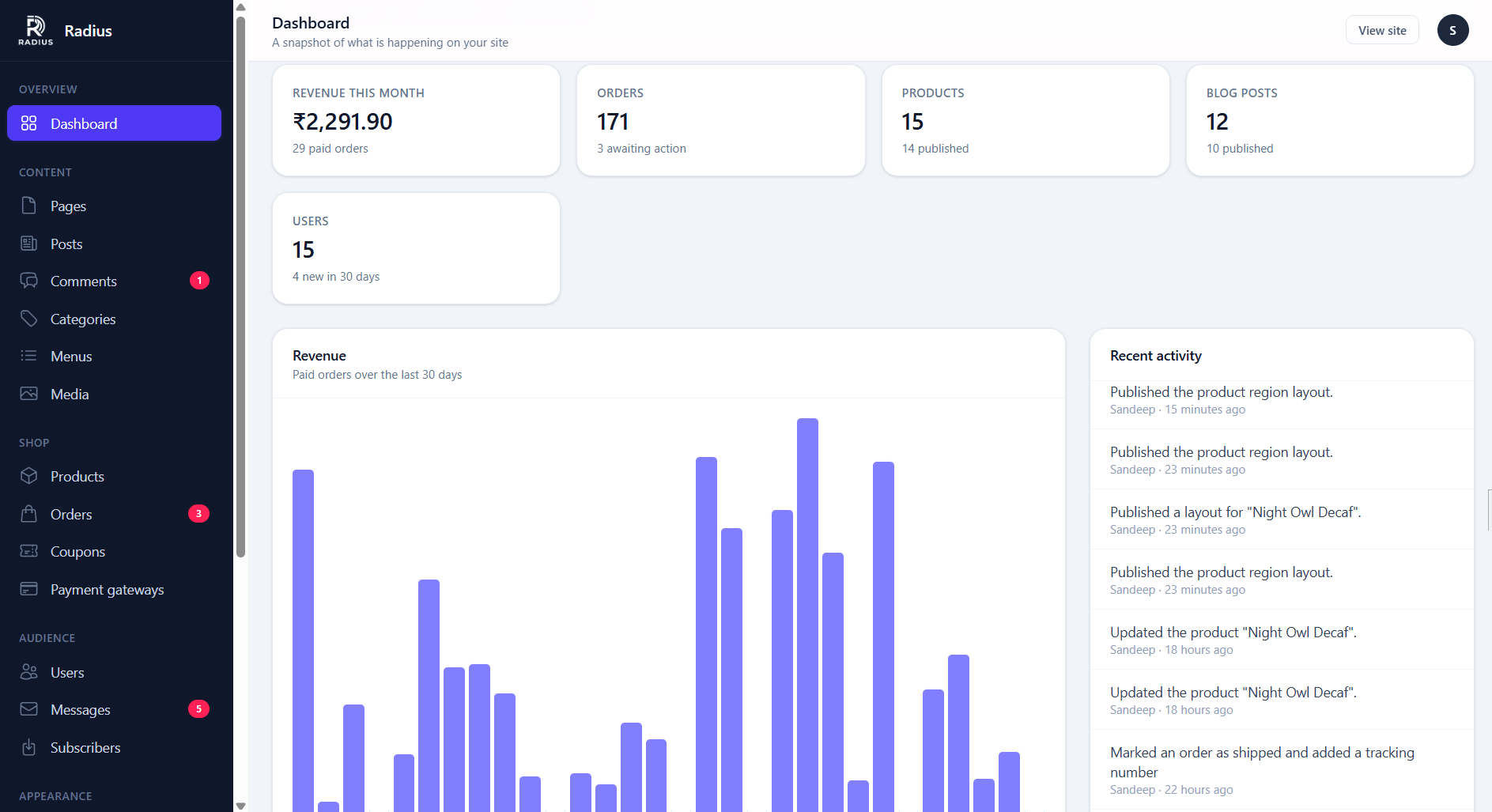
The admin panel at a glance
Where to go next
- Requirements — check your host before you upload anything
- Installation — the four-step wizard, or the command line
- First steps — what to do in the first ten minutes